# 12V vs. 24V Inverters
Use an inverter designed for the nominal voltage of your DC system and verify its full input range. For the same AC load and conversion efficiency, a 24 V system draws roughly half the DC current of a 12 V system.
Canonical URL: https://zaptural.com/guides/12v-vs-24v-inverter/
Last reviewed November 26, 2026
## Start with the source you already have
Read the battery bank or vehicle documentation for nominal voltage and the range it will reach in service. Compare the inverter variant’s input range with the voltage at the unit while charging and under load. A 24 V inverter requires a suitable 24 V DC source.
For an existing vehicle or RV, compare compatible variants first. For a new standalone system, choose the voltage with the battery, charging equipment and other DC loads in view. Check that every component supports the intended arrangement. [Representative inverter specifications](https://www.victronenergy.com/media/pg/Sun_Inverter/en/technical-specifications.html).
## Compare current at the same load
Use AC watts divided by loaded DC volts multiplied by efficiency as a decimal. At **480 W AC** and **90% assumed efficiency**, the example works out to **44.4 A at 12 V** and **22.2 A at 24 V**.
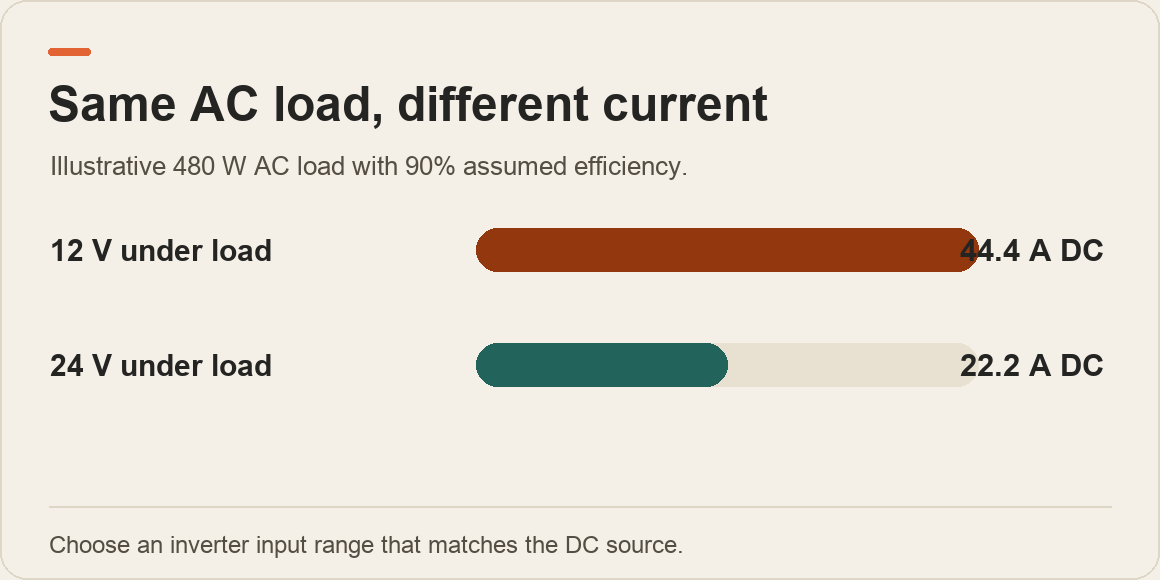
Same illustrative 480 W AC load and 90% efficiency. Doubling the loaded DC voltage halves estimated current.
Lower current changes the requirements for the DC side. Have the cable route, protection and connections verified for the actual equipment. The worked values estimate operating demand and do not specify cable or fuse sizes. [DC wiring and voltage-drop reference](https://www.victronenergy.com/media/pg/The_Wiring_Unlimited_book/en/dc-wiring.html).
## Choose a variant and verify the outputs
Match AC voltage, frequency, socket type and waveform separately. A change in DC input voltage does not change those published AC ratings. Also verify continuous watts and the duration of the largest startup event.
If you already own a compatible 12 V battery system and it can deliver the required current, adding a compatible 12 V inverter may involve fewer changes. If a new 24 V configuration is practical, verify the 24 V charging path and any existing loads that require 12 V.
Take the loaded DC voltage, running watts, startup event, battery discharge limit and expected runtime into the [battery selection guide](https://zaptural.com/guides/how-to-size-a-battery-for-an-inverter/). Then compare the [12 V](https://zaptural.com/power-inverters/12v/) and [24 V](https://zaptural.com/power-inverters/24v/) model criteria.
## References
- [Victron inverter technical specifications](https://www.victronenergy.com/media/pg/Sun_Inverter/en/technical-specifications.html)
- [Samlex sizing and RV product guide](https://samlexamerica.com/wp-content/uploads/2025/02/Samlex-America-RV-Product-Guide-Web.pdf)
- [Victron Wiring Unlimited: DC wiring](https://www.victronenergy.com/media/pg/The_Wiring_Unlimited_book/en/dc-wiring.html)
- [Victron Lithium Smart technical data](https://www.victronenergy.com/media/pg/Lithium_Battery_Smart/en/technical-data.html)
## Related pages
- [12V Power Inverters](https://zaptural.com/power-inverters/12v/)
- [24V Power Inverters](https://zaptural.com/power-inverters/24v/)
- [What Size Inverter Do I Need?](https://zaptural.com/guides/what-size-inverter-do-i-need/)
- [How to Size a Battery for a Power Inverter](https://zaptural.com/guides/how-to-size-a-battery-for-an-inverter/)
[Check battery and inverter fit](https://zaptural.com/guides/how-to-size-a-battery-for-an-inverter/)