# Power Inverter vs. Inverter/Charger
A standalone inverter supplies AC from a compatible DC source. An inverter/charger combines that function with battery charging from a supported AC source. If you need shore power to feed the same loads, verify the model’s transfer or pass-through function separately.
Canonical URL: https://zaptural.com/guides/inverter-vs-inverter-charger/
Last reviewed November 26, 2026
## Map what power needs to do in each mode
Write down which equipment needs AC when shore power or a generator is unavailable. In inverter mode, the battery supplies the DC input. The inverter supplies the compatible AC loads documented for its output.
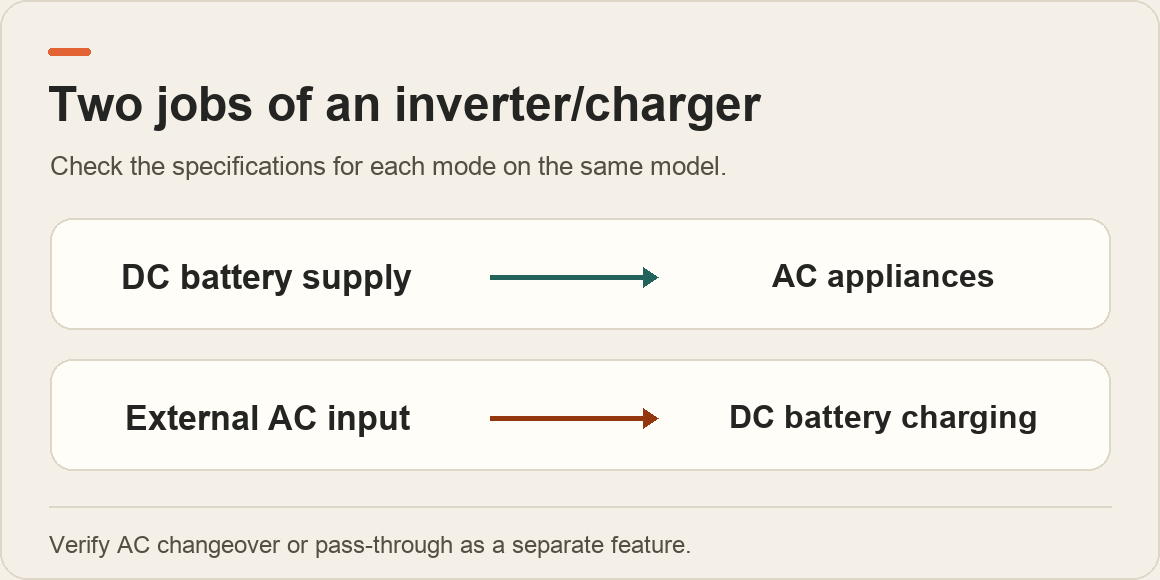
Compare both functions in the exact manual. A transfer function has separate specifications.
When an approved AC source is available, a charger converts that input to the DC charging profile the battery requires. A model with transfer or pass-through may also feed selected AC loads from the incoming supply. Use its diagram to confirm which circuits and ratings apply. [Example inverter/charger documentation](https://xantrex.com/products/inverter-chargers/freedomhf/).
## Check the individual functions on the exact model
For the inverter function, verify DC input range, continuous AC watts, timed surge, output voltage and connector. For charging, compare the supported battery chemistry, charging profile, charge current and accepted AC input.
| Function | Question to ask about the model |
| --- | --- |
| Inverter | Will it support the intended AC loads and their startup? |
| Battery charger | Does it support the battery’s documented charging requirements? |
| AC transfer, where supported | Which circuits does it serve and what ratings apply? |
If an RV already has a suitable converter/charger, list what it provides before replacing equipment. Check whether the missing function is battery-to-AC power or management of the existing AC circuits. [RV converter and charging reference](https://www.progressivedyn.com/frequently-asked-questions/).
## Choose the simplest system that meets the requirement
A camper with a working charger and one plug-in load may only need a standalone inverter and a compatible battery connection. A camper that needs integrated charging and changeover should compare models that document both behaviours.
Use the [RV shore power guide](https://zaptural.com/guides/rv-inverter-shore-power-basics/) to check which outlets need power in each mode. If shopping for a standalone unit, take the AC load list and DC supply details into the [inverter directory](https://zaptural.com/power-inverters/).
Before ordering, draw a simple list of source states and required loads. If the same outlets need to work both parked on battery and connected to shore, have a qualified installer verify the documented transfer equipment against the intended arrangement.
## References
- [Xantrex Freedom HF inverter/charger](https://xantrex.com/products/inverter-chargers/freedomhf/)
- [Xantrex FREEDOM X specifications](https://xantrex.com/products/inverters/freedomx/)
- [Progressive Dynamics converter and charger FAQ](https://www.progressivedyn.com/frequently-asked-questions/)
## Related pages
- [Power Inverters](https://zaptural.com/power-inverters/)
- [What Size Inverter Do I Need?](https://zaptural.com/guides/what-size-inverter-do-i-need/)
- [RV Inverter vs. Converter](https://zaptural.com/guides/rv-inverter-vs-converter/)
- [Which RV Outlets Work on Inverter Power?](https://zaptural.com/guides/rv-inverter-shore-power-basics/)
[Compare standalone inverter models](https://zaptural.com/power-inverters/)