
Car Outlet vs. Battery-Connected Inverters
A vehicle accessory plug is convenient for light loads within the vehicle’s documented outlet limit. Move to a supported battery connection when the planned AC load would exceed that limit or when the inverter manual requires a battery connection.
Last reviewed November 26, 2026
Compare car inverter options1. Find the rating of the exact outlet
Open the owner’s manual for the vehicle, model year and power outlet. Check the outlet’s stated DC limit, whether several outlets share the same circuit, and whether it remains powered with the ignition off. A retailer’s inverter wattage label does not tell you what a particular car circuit can deliver.
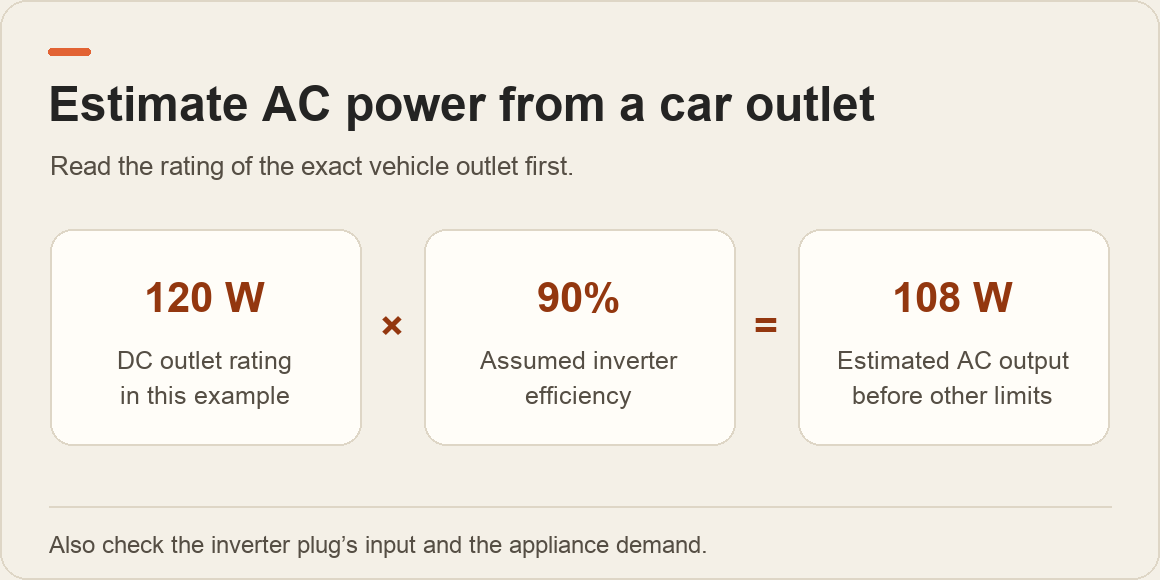
Suppose the manual gives 120 W DC for the outlet and your inverter is 90% efficient at the intended load. The arithmetic estimate is 108 W AC. Compare that result with the inverter plug limit and the device demand. The lowest applicable limit governs. See how to estimate car outlet headroom.
For a shared circuit, include the other equipment drawing from it. If the vehicle manual states a limit across two sockets, check the total even when each accessory has its own plug.
2. Decide when to move to a battery connection
Choose a supported battery connection when the load is beyond the accessory-circuit rating. Check the vehicle’s approved connection points, battery-system voltage, discharge capability and energy management. The inverter manual determines the installation requirements for the exact variant. DC installation reference.
If you need 300 W AC, a 12 V source at an assumed 90% efficiency would supply about 27.8 A under load. Compare that with the vehicle and inverter documentation. A larger inverter does not increase what the accessory outlet can supply.
3. Choose the simplest route that meets the load
| Your task | First thing to check | Follow-up |
|---|---|---|
| Charge a laptop | Adapter AC demand or supported vehicle DC charging | Laptop charging answer |
| Use an AC device while parked | Outlet behaviour and starting-battery reserve | Engine-off answer |
| Run sustained or high-startup loads | Approved battery supply and surge duration | Sizing worksheet |
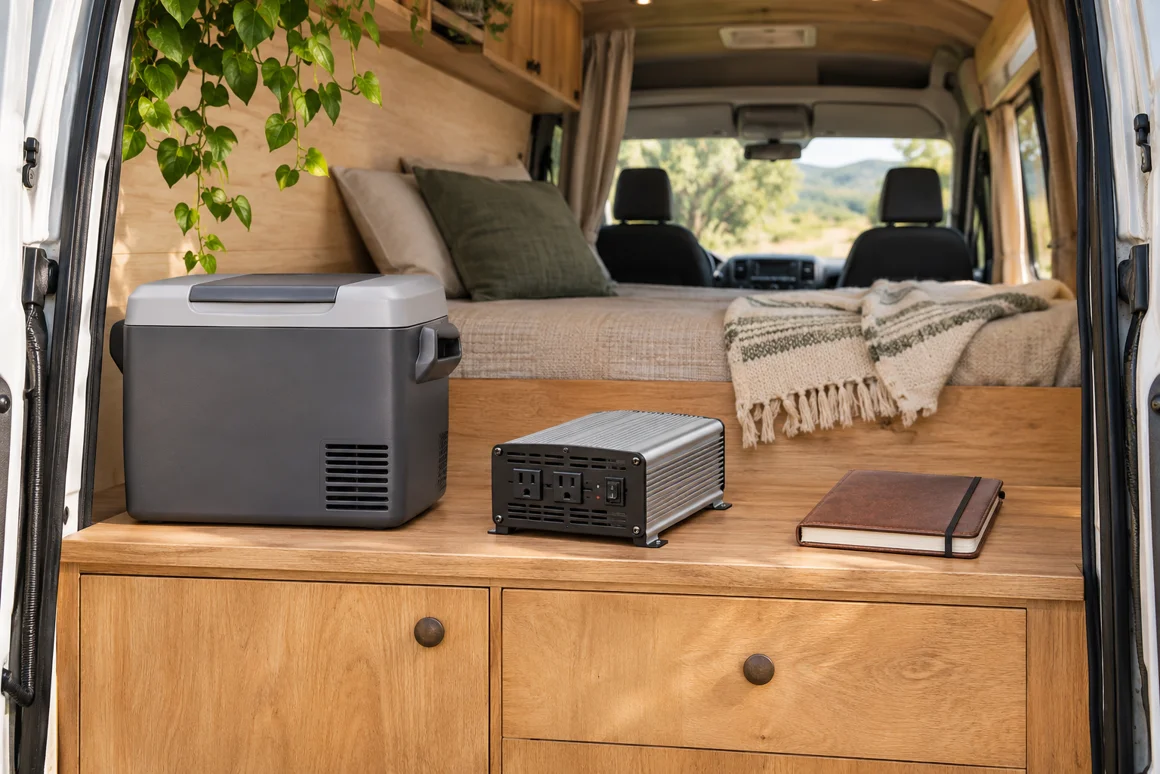
A driver asking about adding a 12 V inverter needed a connection decision before choosing a model. Have the vehicle model and device label ready when comparing the car inverter options. Original vehicle question.
Write the intended AC watts and hours next to the connection result. For an engine-off scenario, keep the starting-battery reserve and the vehicle’s permitted operating conditions in the decision. A suitable dedicated DC charger can simplify a single-device setup when its compatibility is documented.