
What Size Inverter Do I Need?
Choose an inverter that supports the loads you will run together and the largest startup event. Then check the DC source, the AC outlet, and the battery energy needed for the run time. The worked example below turns three appliance labels into a shortlist.
Last reviewed November 26, 2026
Compare inverter wattage classes1. Add the loads that run together
Write down the AC electrical input watts on each device label. For an adjustable or cycling appliance, use the expected running demand for your use case and confirm the maximum you need to support. If a label only gives amps or VA, check the appliance manual for power data instead of treating VA as watts. Inverter ratings and load guidance.
| Example load | Running watts | Watts during compressor start |
|---|---|---|
| Laptop adapter | 90 W | 90 W |
| Small compressor appliance | 120 W | 400 W |
| Lamp | 30 W | 30 W |
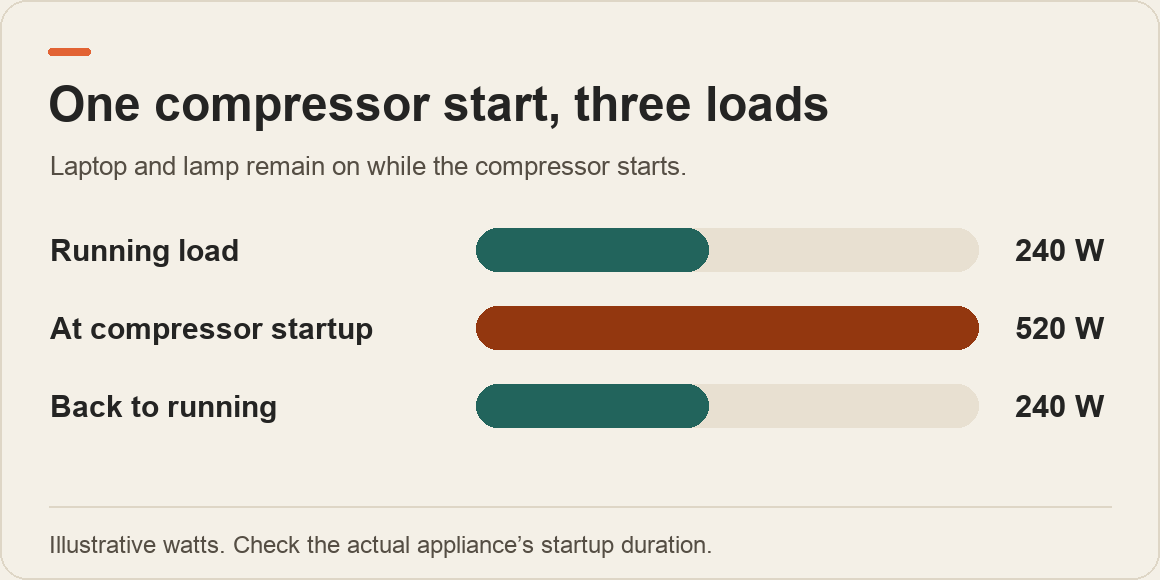
| Total if they overlap | 240 W | 520 W |
All three values are illustrative. Replace them with your own appliance ratings. The resulting 240 W is the continuous load for this combination, before accounting for the inverter’s rating conditions.
2. Check the largest startup event
When the example compressor starts, its draw goes from 120 W to 400 W. The laptop and lamp are already running, so the simultaneous startup event is 90 + 400 + 30 = 520 W. The 400 W already includes the compressor’s draw while starting.
Check the device’s startup duration and the inverter’s surge rating at that duration. If two motors can start together, include both. The continuous-versus-peak explainer shows how to read these ratings. A higher wattage printed on the case gives little useful information without its duration and test conditions. Example timed rating from Xantrex.
3. Estimate running current on the DC side
Divide running AC watts by the DC voltage at the inverter under load, multiplied by efficiency as a decimal. For the example, 240 W ÷ (12 V × 0.90) ≈ 22.2 A. The 90% efficiency is an assumption. Use model data at the expected load where available.
Compare the estimated running demand with the battery or BMS continuous discharge limit. Confirm short-duration discharge and voltage sag separately for startup. Capacity in Ah helps estimate runtime. The BMS discharge limit determines which loads the battery can support at a given moment. Battery discharge fields in a manufacturer specification.
Use the calculator below for running DC current. Start with the example and replace the inputs with your own.
For time between charges, calculate energy in watt-hours using actual load and usable battery capacity. An inverter’s service life is a separate question for the model’s operating conditions and warranty. Battery runtime examples.
Estimate DC running current in amps with AC watts ÷ (loaded DC volts × efficiency as a fraction). At 240 W, 12 V and 90% efficiency, the estimate is 22.2 A.
4. Check the entire power path
Work from the source to the load. A Reddit reader asked for help checking a proposed 12 V bank and 3,000 VA inverter/charger against the manual. That setup needs separate checks for current, AC delivery and battery energy. Original off-grid system question.
| Part of the path | What to verify before ordering |
|---|---|
| DC source | Battery or vehicle supply voltage, allowed discharge, and voltages under load |
| DC connection | Inverter manual, permitted connection, cable routing and required protection |
| Inverter | Continuous watts at operating conditions, surge duration, waveform, and input range |
| AC output | Voltage, frequency, receptacle or approved output, and per-output limits |
| Connected equipment | Running load, worst startup overlap and hours per day |
Have a qualified installer verify the physical installation, protection and grounding against the exact manual. Keep the planned battery and inverter model codes with the diagram. DC wiring and protection reference.
For a campervan or RV, sketch the approved power path from house battery to inverter to assigned AC loads and note the exact manuals. Use the RV circuit guide to identify which outlets are supplied. For an estimate in amp-hours, combine runtime and idle draw with the 12 V versus 24 V current check.
A 12 V to 120 V inverter changes battery DC into AC at its rated output. Confirm the exact specification for the DC input range, AC voltage, waveform and output socket. How DC becomes AC.
5. Apply the worksheet to your setup
- Car: Start with the vehicle accessory circuit and supported plug-in load. Follow the connection guide if the outlet cannot support it.
- Truck: Record which cooking or tool loads can overlap. Use the truck load checklist for startup and operating patterns.
- RV: Identify the outlets assigned to inverter power before adding up their loads. See the shore power guide.
- Backup: Prioritise essential loads and include the intended hours of use. Use the outage load plan and runtime worksheet.
6. Turn the numbers into a shortlist
Keep four values next to each candidate: continuous AC load, highest measured or documented startup event and duration, estimated DC running current, and daily energy need. Compare regional AC specifications, connector limits and the purchase SKU before ordering.
Use the 1,000 W, 2,000 W and 3,000 W comparison to choose a range. Use the Zaptural model directory for model references and ask for the exact variant’s manual if a rating is missing.
Use the 1,000 W, 2,000 W and 3,000 W classes once you have the load total and startup duration. A class is a starting point. A refrigerator may require a bigger startup allowance than its steady draw suggests. Work through the refrigerator example before requesting a model.
| Example power class | Hypothetical running load | Separate check |
|---|---|---|
| 1,000 W | 240 W of combined plug-in loads | Verify the 520 W compressor startup event from the example above. |
| 1,500 W | 1,100 W appliance input plus 80 W of other loads | Verify startup, heating cycle and outlet limits. |
| 2,000 W | A combined running load of 1,550 W | Check other appliances starting while that load is on. |
| 3,000 W | A combined running load of 2,400 W | Verify the documented timed surge, AC output path and available DC current. |
Frequently asked questions
Can I choose an inverter from appliance running watts alone?
Check the continuous running total, the highest simultaneous startup event and its duration, and the DC source’s ability to supply both. Verify the AC outlet and waveform against the load manuals.