
How to Size a Battery for a Power Inverter
Choose a battery that can deliver the inverter’s current and has enough usable energy for your runtime. Check the DC voltage range first, then compare continuous and short-duration discharge limits with the actual AC load.
Last reviewed November 26, 2026
Use the battery sizing worksheet1. Check what the battery and BMS can deliver
Find the battery’s continuous discharge limit and published short-duration limits. Check whether the manufacturer permits the proposed series or parallel configuration. Use the permitted system rating and make sure the inverter input works across the loaded battery voltage range. Example battery discharge specifications.
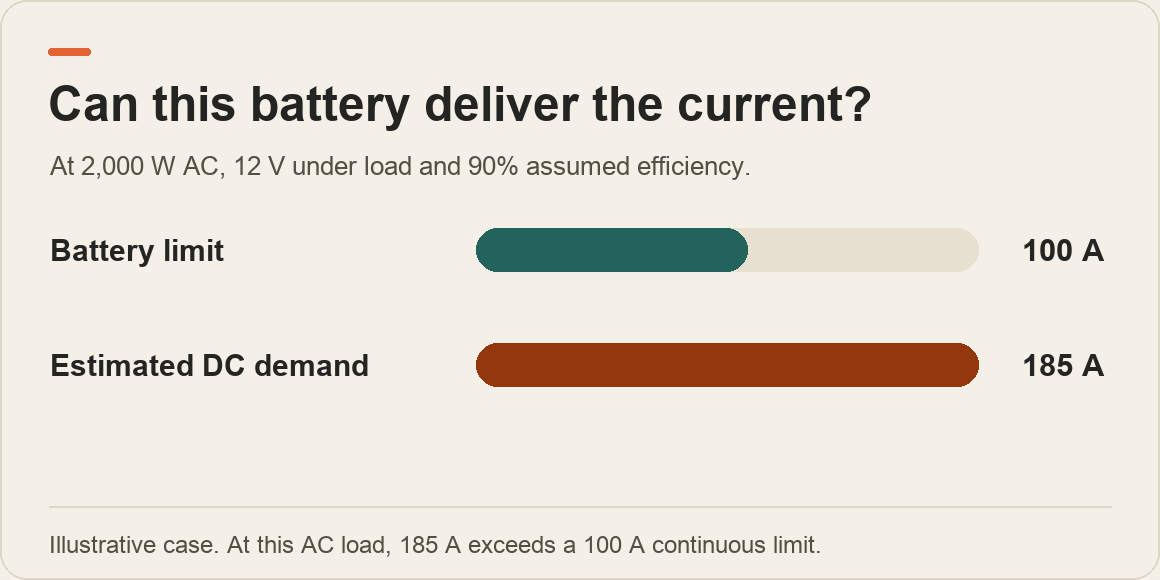
| Hypothetical input | Estimated operating demand |
|---|---|
| 1,000 W AC, 12 V loaded, 90% efficiency | About 93 A DC |
| 2,000 W AC, 12 V loaded, 90% efficiency | About 185 A DC |
| 2,000 W AC, 24 V loaded, 90% efficiency | About 93 A DC |
A 100 A continuous discharge limit would be below the example 185 A demand. Adding nominal Ah alone leaves that mismatch unresolved. Verify startup demand and allowable duration separately. Related user question about a 2,000 W load on a 140 Ah battery.
Check the current at the load you actually plan to run. At 500 W AC, a 12 V loaded input and 90% assumed efficiency, a 2,000 W-rated inverter would draw about 46 A during that operating case. The 185 A check applies if you plan to use its full 2,000 W continuously. Confirm startup and voltage sag for either case.
2. Check energy after verifying discharge
Multiply nominal volts by amp-hours to estimate watt-hours, then adjust for the battery maker’s allowed usage and your reserve. At a hypothetical 12.8 V × 140 Ah, nominal energy is 1,792 Wh. Use the runtime worksheet to add the actual load, efficiency, duty cycle and idle draw.
The same battery may easily run a small load for hours and still be unable to start a larger one. Keep the Wh estimate and discharge check as two separate worksheet fields.
3. Size a battery for a worked two-hour example
Suppose the load draws 500 W AC for two hours. That calls for 1,000 Wh AC. At 90% assumed inverter efficiency, allow roughly 1,111 Wh DC for the AC load. Account separately for other equipment and time the inverter stays on with no load.
If you plan to use 80% of nominal battery energy, divide 1,111 Wh by 0.80. The result is about 1,389 Wh nominal, or 109 Ah at 12.8 V nominal. A nominal 120 Ah candidate can meet this example’s energy target if its usable energy at the load supports it.
| Check | What the example requires |
|---|---|
| Operating current | About 46 A at 12 V under load |
| Battery energy | About 1,389 Wh nominal, before other losses or loads |
| Startup | Verify the peak current, duration and loaded voltage for the actual appliance |
| Buying decision | Confirm the exact battery and BMS ratings in the datasheet |
For 2,000 W AC for one hour, the same 90% efficiency and 80% usable-energy assumptions give about 2,778 Wh nominal, or 217 Ah at 12.8 V nominal. The same setup would also have to support the estimated 185 A running demand at 12 V under load, plus any separate startup event.
Look for the required usable Wh and a documented continuous and short-duration discharge rating on the same battery model. If the battery’s BMS specification or the inverter’s DC input range is missing, request it before selecting a variant. Manufacturer example of separate Ah and discharge ratings.
4. Verify the complete operating range
Check expected temperature, loaded voltage, the battery protection thresholds and the exact inverter’s AC output rating. Compare both manuals before purchasing. Have the cable, DC protection and approved installation reviewed for the actual equipment and layout. DC wiring reference.
Save the battery model, continuous limit, short-duration limit, allowable DC range and expected AC demand. The current estimate helps you prepare those inputs for a model enquiry.