
How Long Will a Battery Run a Power Inverter?
Estimate runtime in watt-hours. Start with the battery energy the manufacturer allows you to use, then divide by the average DC draw from the inverter and any other loads. For a device that cycles, include the time it runs and the inverter’s draw while waiting.
Last reviewed November 26, 2026
Check battery compatibility1. Convert the battery rating to usable energy
Multiply nominal battery voltage by capacity in amp-hours to estimate nominal watt-hours. Apply a usable fraction from the battery documentation and the reserve you want. Check the battery’s discharge limit separately from the energy calculation.
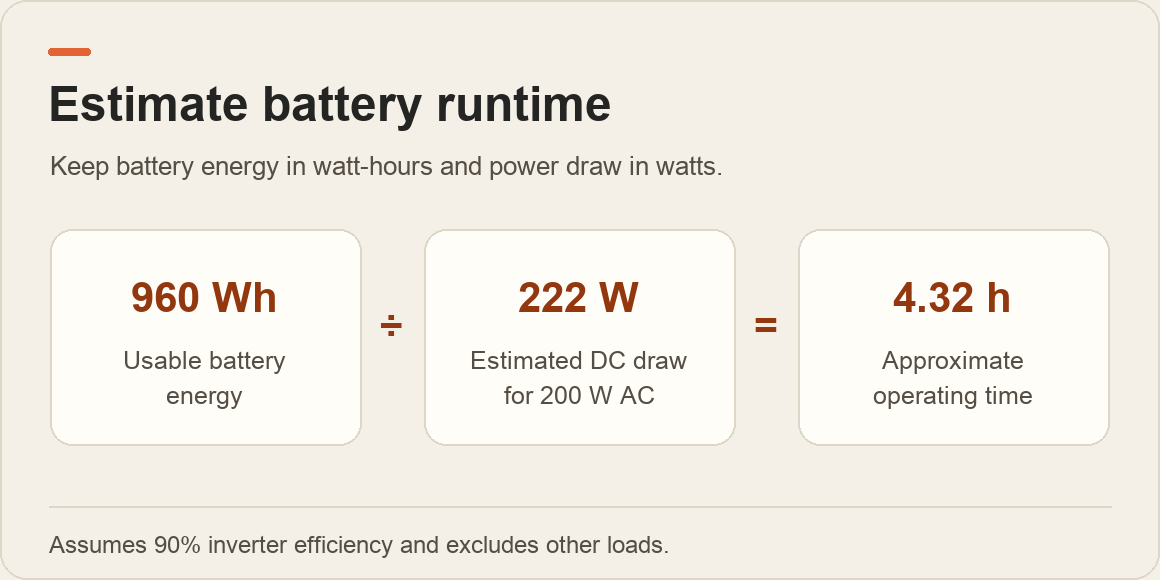
A hypothetical 12 V × 100 Ah = 1,200 Wh bank with an assumed usable fraction of 80% gives 960 Wh available for this estimate. The 80% is a chosen input for the example. Use the battery’s requirements for the actual system. Battery rating examples.
2. Work one constant-load example
At 200 W AC and assumed 90% efficiency, the estimated DC draw is 200 ÷ 0.90 ≈ 222 W. With 960 Wh usable, the ideal estimate is 960 ÷ 222 ≈ 4.32 hours, before independent DC loads, temperature limitations or a cutoff under load.
| Input change | How it affects the estimate |
|---|---|
| The AC load doubles at the same efficiency | DC power draw roughly doubles. The estimate halves. |
| There is another 20 W DC load | Use 222 + 20 = 242 W total, or about 4.0 hours. |
| The battery voltage sags to the cutoff | The inverter can stop earlier than the Wh estimate suggests. |
3. Allow for cycling, idle draw and other equipment
For a refrigerator, use a measured watt-hour total for a representative period when feasible. If you estimate by duty cycle, use AC running power for the on-period and inverter idle draw for the time when it stays on with no load. Include direct DC loads separately. Avoid counting the same inverter losses twice if your measurement already includes them.
A van owner asked how to stretch a 100 Ah battery with both direct DC loads and a 240 V inverter. Make separate entries for the fridge, lights, charging and time the inverter stays on. Check the model’s no-load specification and the battery’s usable energy. Original van question · Example no-load specification.
4. Record a realistic range
Run a low, expected and high scenario based on appliance use and operating conditions. Use the high-load case to check current and startup support. Use the expected energy case to plan the recharge interval or decide whether capacity is sufficient.
If the estimate is too short, compare reducing the loads, switching off unused inverter time and adding verified battery capacity. The battery selection guide covers current limits and reserve.