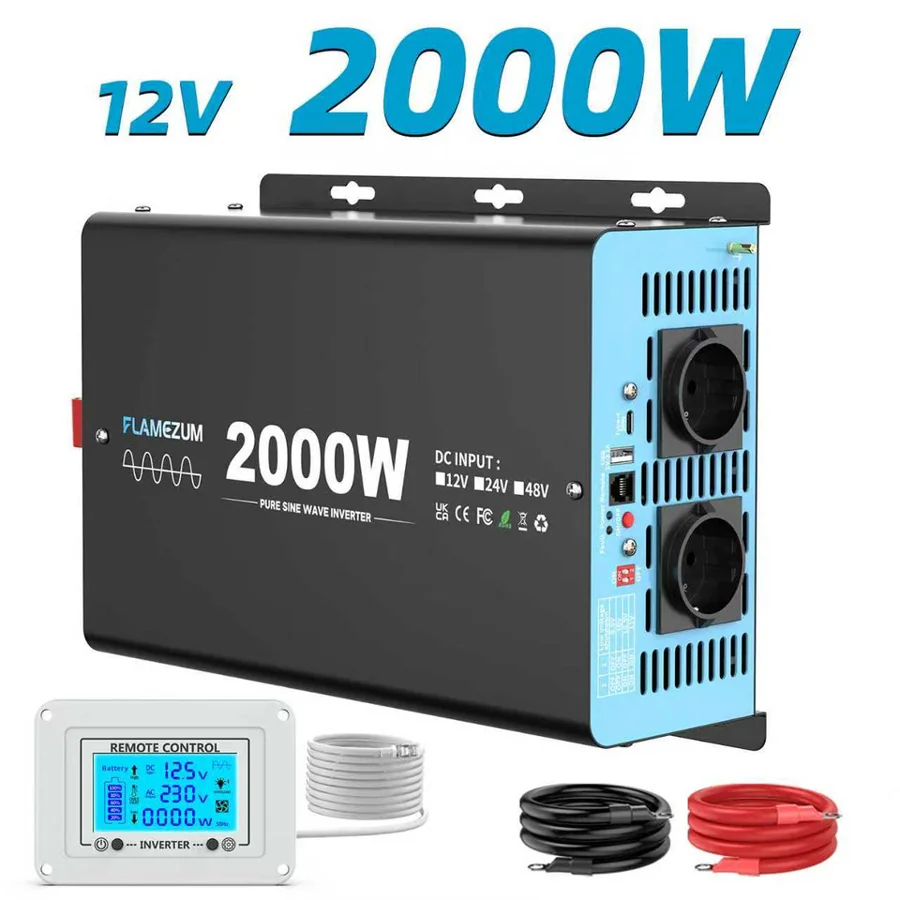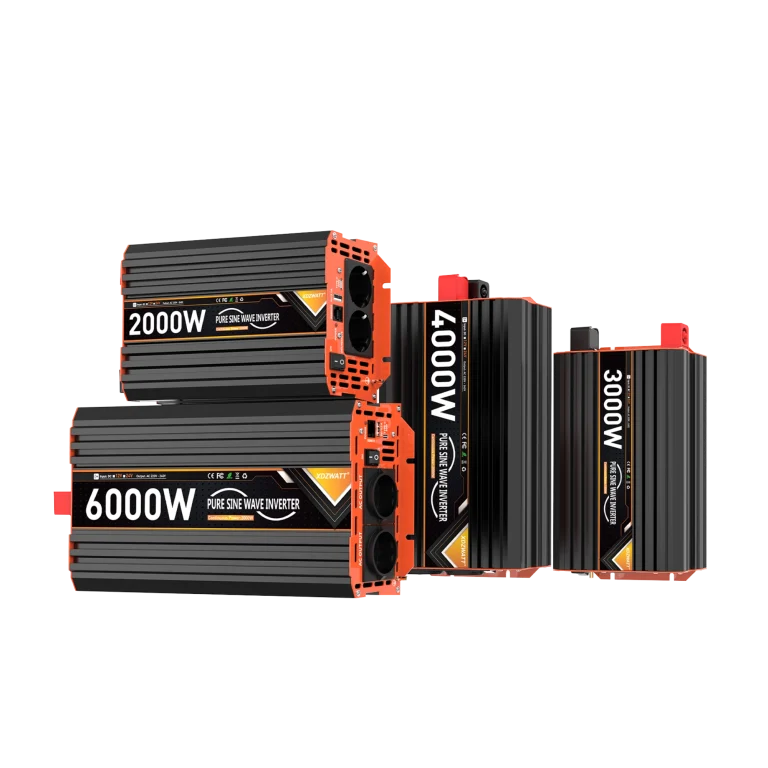
BLE 2000W
Series image
View model
Compare 2,000 watt pure sine wave inverters using the documented continuous rating, timed surge and AC outlets. At full 2,000 W output, a 12 V battery system must deliver roughly 185 A DC at 90% assumed efficiency. Check the exact 12 V or 24 V variant before ordering.
Check each model’s documentation for the application, power rating and market variant.
Use the model’s continuous output at the expected temperature and ventilation conditions. A 2,000 W peak label can describe a much smaller continuous inverter. Check timed surge and any per-outlet limits separately. Timed power and temperature examples.
An illustrative 1,100 W input microwave and 450 W of other running equipment total 1,550 W. If a separate appliance starts while both remain on, add that event’s demand and compare the timed rating. If either load connects to a separately limited outlet, check that outlet as well.
| Same 2,000 W AC load | Illustrative DC current at 90% efficiency |
|---|---|
| 12 V under load | 185 A |
| 24 V under load | 93 A |
Confirm the battery, BMS and DC connection can supply the relevant current while staying within the inverter’s input range. Full current example · Battery discharge sizing.
Use the BLE 2000W and TK 2000W model references to identify the family. Ask for the variant’s written continuous rating, surge time, pure sine wave specification, DC input range and AC socket configuration.
When comparing prices or reviews, align voltage, output features, included accessories, warranty and seller SKU. Request a matched country-specific offer.
At full 2,000 W AC output and 90% assumed efficiency, it draws about 185 A at 12 V under load or 93 A at 24 V. Use the actual load, loaded DC voltage and efficiency for your system.
Record the destination market, quantity, intended load and the required DC input, AC outlet and waveform. Build a brief you can copy for a supplier.