
1,000 W vs 2,000 W vs 3,000 W Inverters
Start with the smallest continuous wattage class that covers your sustained load and the largest startup event. Compare the DC current, AC connector and exact model rating before buying. A higher wattage changes what the whole system must supply.
Last reviewed November 26, 2026
Calculate the load and battery currentCompare the power classes on the same assumptions
A reader asked whether a 2,000 W inverter was enough for their setup. The answer depends on the connected load and supply, not the size label alone. Original sizing question.
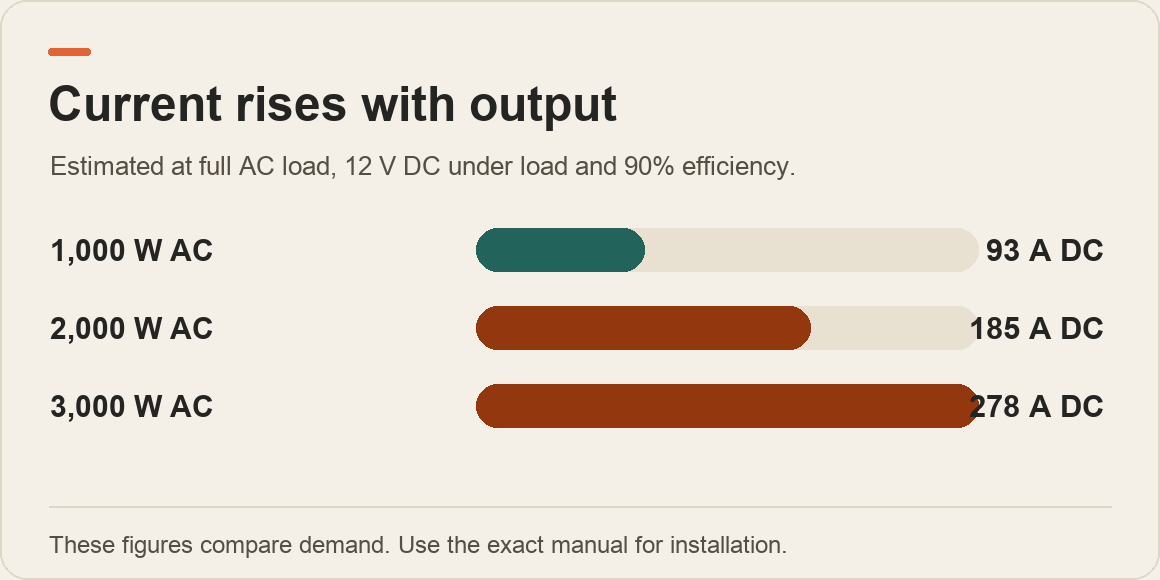
| Continuous AC class | Approximate current at 12 V | Approximate current at 24 V | What to verify |
|---|---|---|---|
| 1,000 W | 93 A | 46 A | Outlet rating, continuous load and startup duration |
| 2,000 W | 185 A | 93 A | Battery discharge, loaded voltage and heat conditions |
| 3,000 W | 278 A | 139 A | DC limits, approved AC output and the model’s rating conditions |
Estimates use full stated AC load, DC voltage under load and an assumed 90% efficiency. Divide watts by voltage × 0.90. These numbers compare demand and are not installation or fuse ratings. Battery discharge reference · Example timed inverter ratings.
Work through a 750 W load with a timed startup
Suppose your planned equipment and concurrent loads total 750 W running and 1,850 W for two seconds at startup. A candidate rated at 1,000 W continuous and 1,800 W for two seconds clears the running requirement and falls short during startup.
A candidate rated at 2,000 W continuous and 2,400 W for two seconds clears both wattage checks at those stated conditions. At 12 V under load and 90% assumed efficiency, 750 W is about 69 A DC while running. Confirm the battery can support the startup event and keep its voltage within the inverter’s input range.
If those are the only intended loads and the verified 2,000 W system passes the DC and AC checks, the example gives no additional output requirement for the 3,000 W class. Re-run the comparison if equipment will start simultaneously or the temperature changes the published continuous rating.
Check the actual model and the AC output
Compare the datasheet’s continuous watts and peak watts with their duration and conditions. A model identifier may include a wattage-like number. Use verified continuous output and regional AC specifications when assigning a wattage class.
Look at the individual socket or other approved AC output rating. Some products describe a different option for delivering the complete unit output. Example output specifications.
Choose a range and build the shortlist
Run the sizing worksheet with your own loads. Then review the 1,000 W, 2,000 W and 3,000 W product pages. Confirm the model manual and local SKU before purchasing.