
What Is a Power Inverter?
A power inverter turns DC electricity from a compatible battery or other DC source into AC electricity for devices designed to plug into AC. It draws energy from the supply while it runs. Choose it based on the source, the appliances and the output they require.
Last reviewed November 26, 2026
Explore power inverter optionsHow DC becomes AC
A battery provides direct current. An inverter uses electronic switching to create an alternating output at a specified voltage and frequency. Manufacturers list the output waveform alongside those electrical ratings. Manufacturer inverter FAQ.
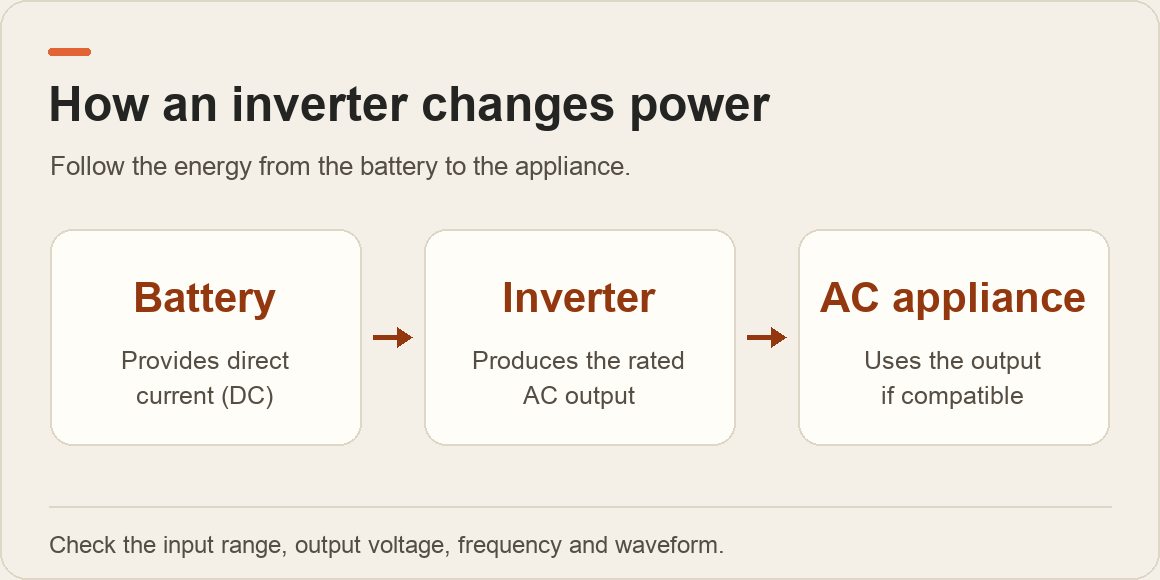
The inverter’s power rating describes what it can supply under specified conditions. The usable energy in the connected battery and the load determine how long it can operate. To estimate that time, move from watts to watt-hours with the runtime guide.
When a power inverter is useful
A typical use is a vehicle or RV with a suitable DC supply and equipment that expects an AC outlet. If the equipment already accepts compatible DC power, compare a manufacturer-approved DC adapter before adding an inverter.
For example, a laptop with an AC-only adapter may need an inverter. A compatible car charger can be another route when the laptop supports it. Check the device requirements and the car connection guide before comparing hardware.
Read the ratings that decide compatibility
Read the inverter and appliance labels together. Start with the inverter’s compatible DC input range, then match AC voltage, frequency, connector and any required waveform. Check the electrical input watts of the equipment that will run together.
| Rating to record | What it tells you |
|---|---|
| DC input range | Which supply can feed the inverter |
| AC output, connector and waveform | Which equipment can use its output |
| Continuous watts | How much simultaneous running load the inverter supports |
| Peak watts and duration | Which documented startup events it can support |
A motor may draw more power at startup than it uses once running. For a proposed load list, the sizing guide shows how to calculate the running total and the largest startup event. Manufacturer ratings example.
Choose the right type of equipment
If you need AC from battery power, shop for an inverter that meets the electrical ratings you collected. If you also need to recharge the battery from a shoreline or other supported AC supply, check an inverter/charger or a separate compatible charger. Example inverter/charger documentation.
Start with the power inverter catalog, or compare car inverter connections if you already know your vehicle and load.
What do pure sine wave and modified sine wave mean?
Both describe AC output. A pure sine wave inverter produces a smooth waveform, while a modified sine wave inverter produces a stepped approximation. Use manufacturer requirements to decide which your equipment accepts. See the waveform comparison · Compare Zaptural model references.
Inverters, converters, chargers and transfer switches
A device described as a DC-to-AC converter is doing the job of an inverter. In an RV, “converter” often means a unit that takes AC shore power and supplies DC loads. A combined inverter/charger adds a charging function. Verify transfer or pass-through separately on the exact model. RV converter guide · Inverter/charger selection.
What is split-phase inverter output?
North American 120/240 V split-phase service supplies 120 V from either line to neutral and 240 V between the lines. Verify AC output specifically in battery inverter mode. One documented inverter/charger passes through split-phase shore input and supplies single-phase 120 V in battery mode. That mode distinction is essential when a 240 V load must operate off-grid. Manufacturer example.
Frequently asked questions
Does a power inverter store electricity?
A basic inverter converts energy supplied by a compatible source. The connected battery provides the stored energy.