
Car vs Truck vs RV Power Inverters
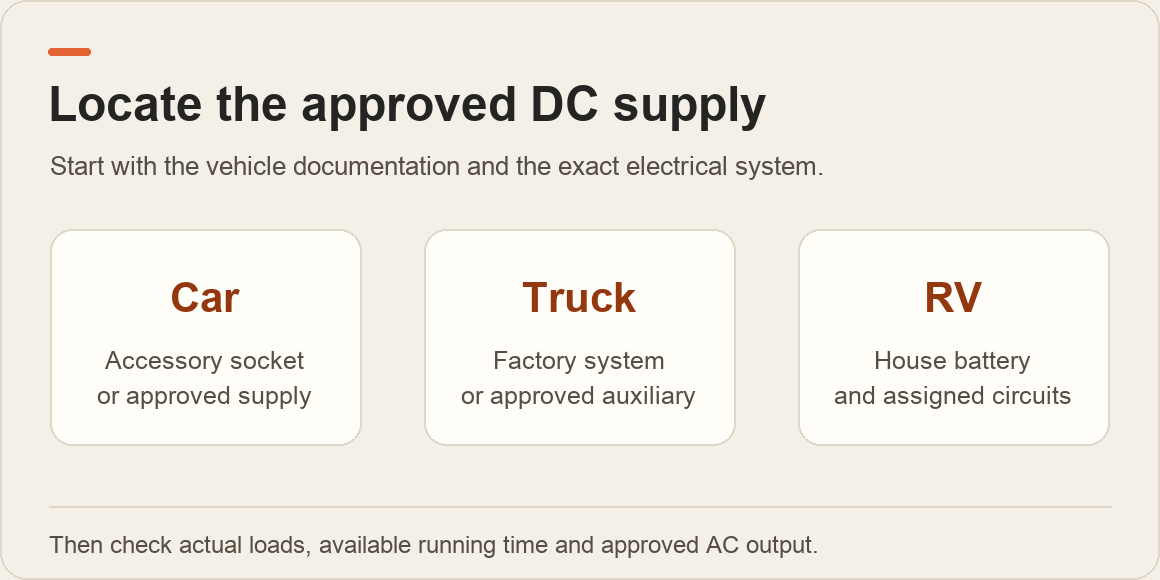
Start with where the DC power comes from and which AC devices need to run. A car accessory outlet, a truck’s approved supply and an RV house battery are different starting points for the same sizing process.
Last reviewed November 26, 2026
Work out your required outputCompare the three buying paths
| Vehicle type | First check | Typical decision to make | Next step |
|---|---|---|---|
| Car | Accessory outlet rating and usable AC demand | Plug-in model or supported battery connection | Car connection guide |
| Truck | Factory inverter or approved auxiliary supply | Cab appliance choice, or support for tools and their startup | Truck load checklist |
| RV | House battery, available AC circuits and shore power | Which circuits and transfer or charger functions you need | RV source guide |
For a truck owner using a 1,200 W inverter, choosing a lower-input appliance was part of the decision. A camper owner asked about supplying the existing AC circuits. These are separate selection tasks. Truck appliance question · Camper circuit question.
Check fit before selecting a model
Record supplied DC voltage, intended AC input watts and startup, output voltage and connector, and expected runtime. Confirm power limits in the vehicle and inverter documentation. If the installation involves existing AC circuits, have the equipment and protection checked by a qualified installer. Manufacturer AC and transfer example.
In a car, an example 60 W AC load needs about 67 W DC at 90% assumed efficiency before separate loads. Put that figure against the exact accessory socket and inverter plug input limits. For a device that supports USB-C or another documented in-vehicle DC option, check the adapter and its shared port limits. Laptop charging options.
For a work truck, plan around what runs together. An illustrative tool that reaches 900 W while starting plus an already running 150 W charger puts 1,050 W on the inverter during that event. Compare the event duration with documented factory or auxiliary inverter limits. Truck load example.
In an RV, trace the desired receptacles to the house system and note where shore power already serves them. A portable inverter intended for a plug-in load and an inverter/charger supplying assigned circuits have different output, transfer and recharge requirements. RV outlets and power sources.
Continue by vehicle
Use the car, truck or RV selection page for the matching context. Bring your labels and intended load into the sizing worksheet.
Put the intended loads, simultaneous startup demand and chosen DC source beside the exact manual and shopping listing. If the local SKU omits output voltage or outlet details, get those specifications before ordering.