
How to Compare an Inverter and a Power Station for Your Loads
Start a side-by-side worksheet using the same appliance loads and runtime for both options. An existing battery changes what you need to buy. A power station bundles more of the system in one enclosure and still needs to meet the same AC and energy requirements.
Last reviewed November 26, 2026
Compare the two buying routes1. Inventory the equipment you already own
For a standalone setup, record your battery’s voltage, usable energy and continuous discharge limit. List any compatible charging system and approved connection already in place. A Reddit reader wanted to reuse a LiFePO₄ battery without buying the same storage capacity again inside a power station. Original van owner’s question.
- Standalone route: Record what you would still need for inverter, charging, protection and installation.
- Station route: Record the unit’s own usable energy, charging inputs, maximum AC and DC output and supported expansion.
Keep the exact models and manuals beside the equipment list. A battery that cannot deliver the needed current, or a station with an unsuitable AC output, falls out of the comparison even if the advertised energy looks sufficient.
2. Compare the two on the same load schedule
Enter running watts, highest startup event and hours of use. In a hypothetical comparison, 100 W for 5 hours requires 500 Wh AC. If a standalone inverter is assumed to be 90% efficient at that load, allow about 556 Wh from the DC source before idle or other DC loads.
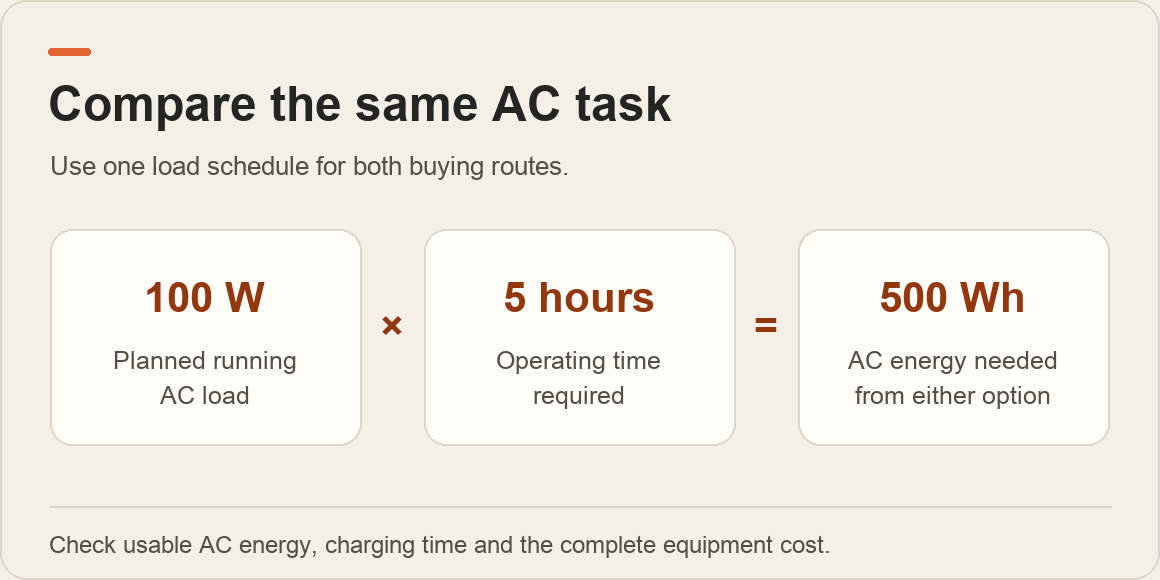
For a station, use the maker’s delivered AC energy or a documented test at a similar load when available. Compare published charging input, time to replenish and available outlets. The runtime guide works through the assumptions.
3. Compare total costs and the practical fit
| Record for each shortlisted option | What to include |
|---|---|
| Equipment cost | Exact model, needed accessories, and installation if applicable |
| Use and charging | Portable weight or installed footprint, plug type, expected recharge source |
| Future service | Replaceable components, documented expansion and regional support |
Use the complete comparison to choose a route. If you plan to reuse an external battery, verify the proposed inverter’s electrical fit in the battery guide before buying.
Price the complete options using the same purchase date, region and accessories, then keep the estimates with the load worksheet. For example, a system that reuses a permitted existing battery may need an inverter and approved installation. A station price should include any extra charging equipment the trip requires.
Before buying, make a pass/fail checklist for AC startup support, usable AC Wh, expected recharge time and service access. Eliminate options with a missing specification if it determines whether the system can do your task.