
Standalone Inverter vs Portable Power Station
Start with a standalone inverter if you already have a compatible battery and an approved way to connect and recharge it. Start with a power station if portability and a single enclosed system are important. Compare both on usable AC energy, not the nameplate watt-hours alone.
Last reviewed November 26, 2026
Use the same-load worksheetWhich option suits your situation?
A van owner with an existing LiFePO₄ battery wanted AC power without paying for another battery as part of a power station. Start by pricing only what each route still needs. Original buyer question.
| Decision | Standalone inverter and battery | Portable power station |
|---|---|---|
| Use existing storage | May reuse an electrically compatible battery | Uses the station’s own storage and documented expansion |
| Installation | Depends on the battery, protection, mounting and AC connection | Enclosed unit includes inverter and battery, with documented output and charging ports |
| Output and energy | Compare inverter watts and battery Wh independently | Compare published AC watts, startup support and delivered AC Wh |
| Recharge | Depends on the separate charging system | Compare supported charging inputs, power and recharge time |
| Future repair or expansion | Check component compatibility and support | Check battery expansion and service terms for the exact station |
Make both quotes comparable
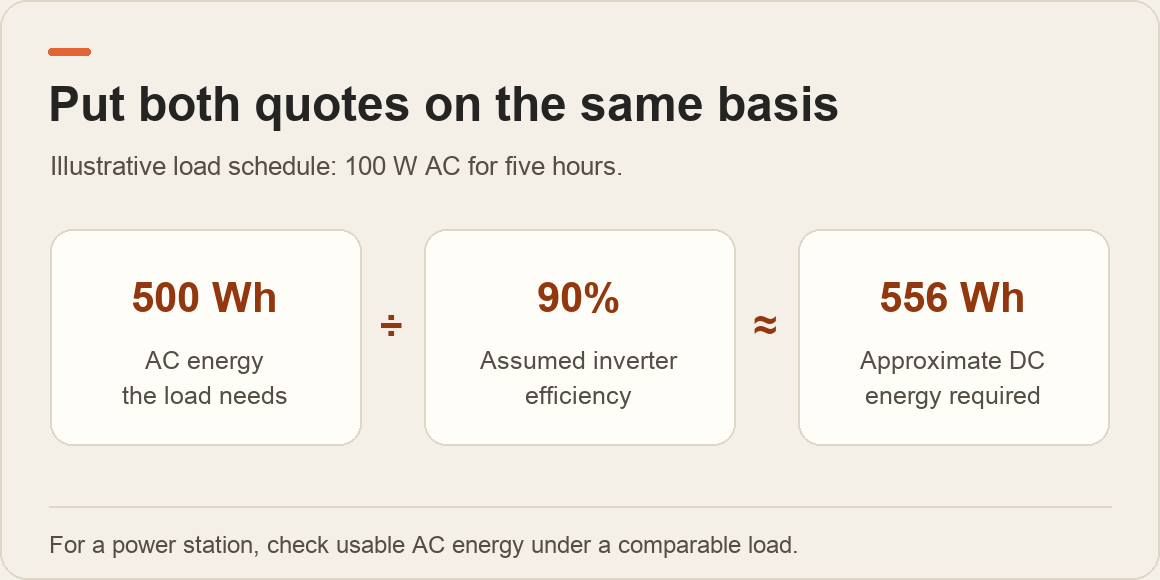
Use the same AC load schedule. If you need 100 W for 5 hours, your AC target is 500 Wh. Compare the whole bill, including battery, charger, installation and required accessories for a standalone system. For a station compare the delivered AC energy at a similar load, outlet ratings and the time to recharge it.
Record the source and date of each specification. Product availability, delivered energy and local support vary by exact model and market. Battery specification example · Manufacturer runtime reference.
For a reusable 12.8 V, 100 Ah battery with 80% planned usable capacity, the DC budget is 1,024 Wh. Supplying 500 Wh AC at 90% assumed efficiency takes about 556 Wh DC before other loads. That leaves about 468 Wh DC in the planned battery budget. Confirm that the battery supports the actual continuous and startup current, and that your charger can replenish the energy in the time available.
A station independently measured or manufacturer-rated for 500 Wh delivered AC at a comparable load would meet the calculation with 0 Wh left in that test. If a quote lists 500 Wh battery capacity alone, ask for usable AC energy at a similar load. Check recharge power on the input you actually have, such as the supported vehicle input.
Choose based on how the system will be used
An installed system makes sense when you have room for a compatible battery, protection, mounting and charging, and the quote credits the equipment you already own. Check whether the reused battery can carry the load at the temperatures and travel conditions where you will operate it.
An enclosed station is easier to move between locations when its weight, outlet layout and recharge options suit the job. Before committing to it, check which individual components are serviceable, what expansion is supported and what happens if your AC energy needs increase.
Put your shortlist to work
Use the load worksheet to enter your own equipment and required operating hours. If you decide to reuse a battery, check its discharge rating in the battery sizing guide and review Zaptural model references.